




Help customers choose
Large catalogues, complex specifications and fragmented product data make it difficult to find a suitable product. Guided discovery can clarify needs and reduce the choices to a useful set.
Commerce AI
Turn large catalogues, complex buying decisions and repetitive commerce workflows into guided AI experiences and controlled internal tools.
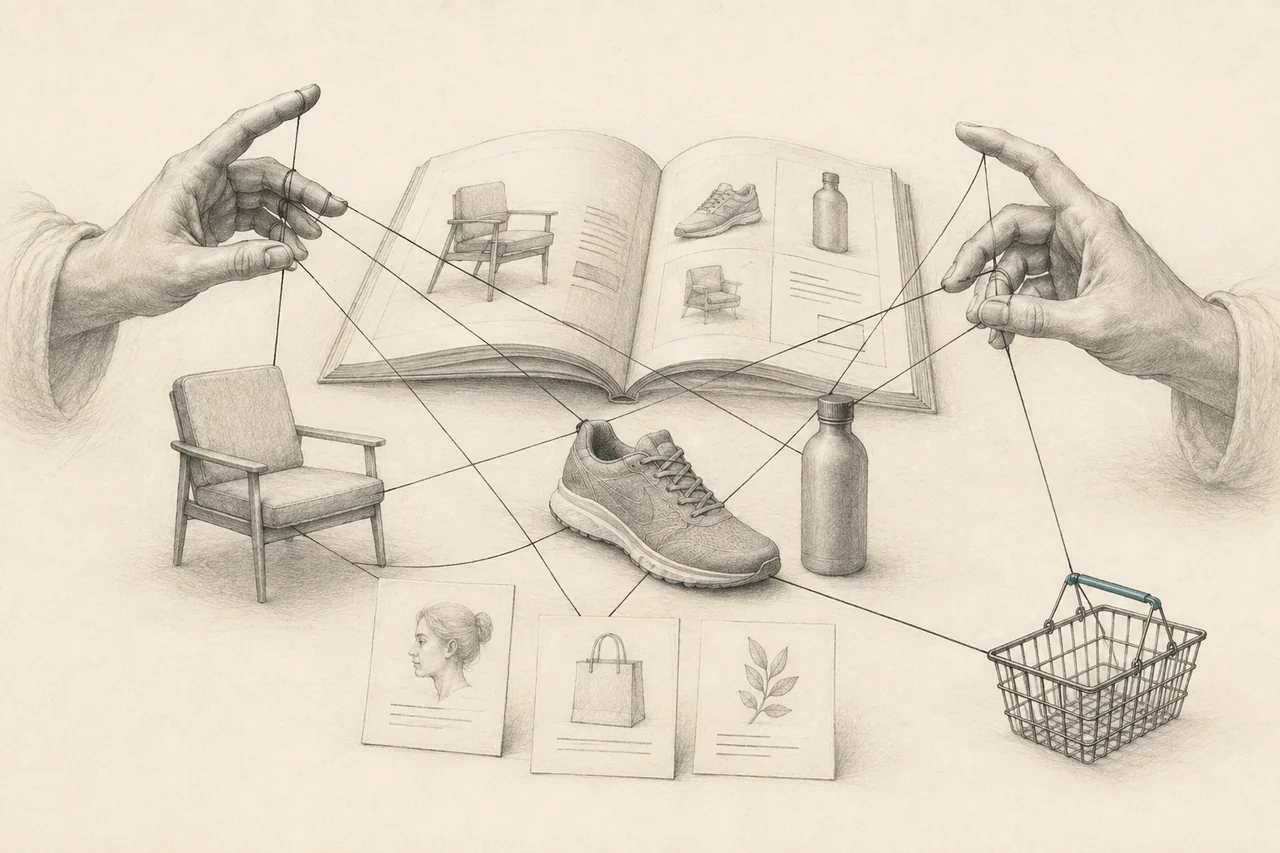
Built around your stack
Possible connections, scoped to your systems and permissions.
The business problem
Start with a specific point of friction. A shopper may know the job a product must do but not the right category or specification. An operator may know what needs updating but be slowed down by disconnected tools and approval steps.
Large catalogues, complex specifications and fragmented product data make it difficult to find a suitable product. Guided discovery can clarify needs and reduce the choices to a useful set.
Inconsistent content, slow PDP operations and repetitive enrichment leave teams copying information between spreadsheets and tools. A structured workflow can make ownership and review visible.
Merchandising workload and repeated pre-purchase support questions compete for attention. Connect approved product knowledge to useful explanations, comparisons and human handoff.
See the workflow
Select a step to see how the context, output and controls connect.
A useful experience begins with what the person needs to achieve, before catalogue categories or product names.
Find an eligible set using catalogue attributes, stock and merchant rules. Make missing information visible.
Present a clear comparison or route a catalogue task to the operator who can approve it.
How the system works
Capture the buying need or catalogue task, including constraints.
Bring together reliable sources, attributes and merchant policies.
Find relevant information, prepare an answer and check the result.
Show explainable choices or a reviewable draft.
Send the next action to the right destination with control intact.
Inventory, compatibility and pricing constraints should shape the result before it reaches a customer. Brand rules and defined compliance requirements belong in content validation. Merchant controls can expose exclusions, overrides and escalation paths; production publishing can require an explicit approval. The system should say when information is missing instead of filling a gap with an unsupported claim.
The architecture can connect to Shopify, a commerce API, PIM, ERP, product feeds, CRM, analytics and a data warehouse. An audit checks available APIs, access permissions, data freshness and ownership before the integration scope is agreed. Existing systems can remain the source of truth while a focused product layer supports one customer journey or internal team.
First identify a buying or operational problem worth solving. Then define the workflow, customer experience, data and controls in a product sprint. Build a focused MVP against agreed scenarios, and use observed behaviour and operator feedback to decide what to improve. Measure useful discovery, completed actions and review effort against a baseline; expansion should follow evidence.
Related
FAQ
Yes. A project can add a custom intelligence or operations layer around the existing store. API access, permissions and platform constraints are assessed before implementation.
No. Begin by inspecting a representative product set. Missing fields, inconsistent attributes and unreliable sources can become part of a bounded enrichment and validation workflow.
Yes. Availability checks, compatibility constraints and merchant exclusions can restrict eligible products before ranking. The workflow should define how stale or unavailable data is handled.
Yes. Catalogue review, PDP maintenance, enrichment and approval tools can use the same product information with separate permissions and interfaces.
Yes. One category, customer decision or internal process is a useful starting boundary. There is no need to replace the whole ecommerce stack.
Define the first useful release
Start with your catalogue, current process and the outcome you want to improve.