



Understand the job
Capture the goal, use case and context that explain why the customer is shopping.
AI Product Discovery
Turn natural-language needs into a small set of relevant, explainable product choices grounded in your real catalogue and business rules.
Built around your stack
Possible connections, scoped to your systems and permissions.
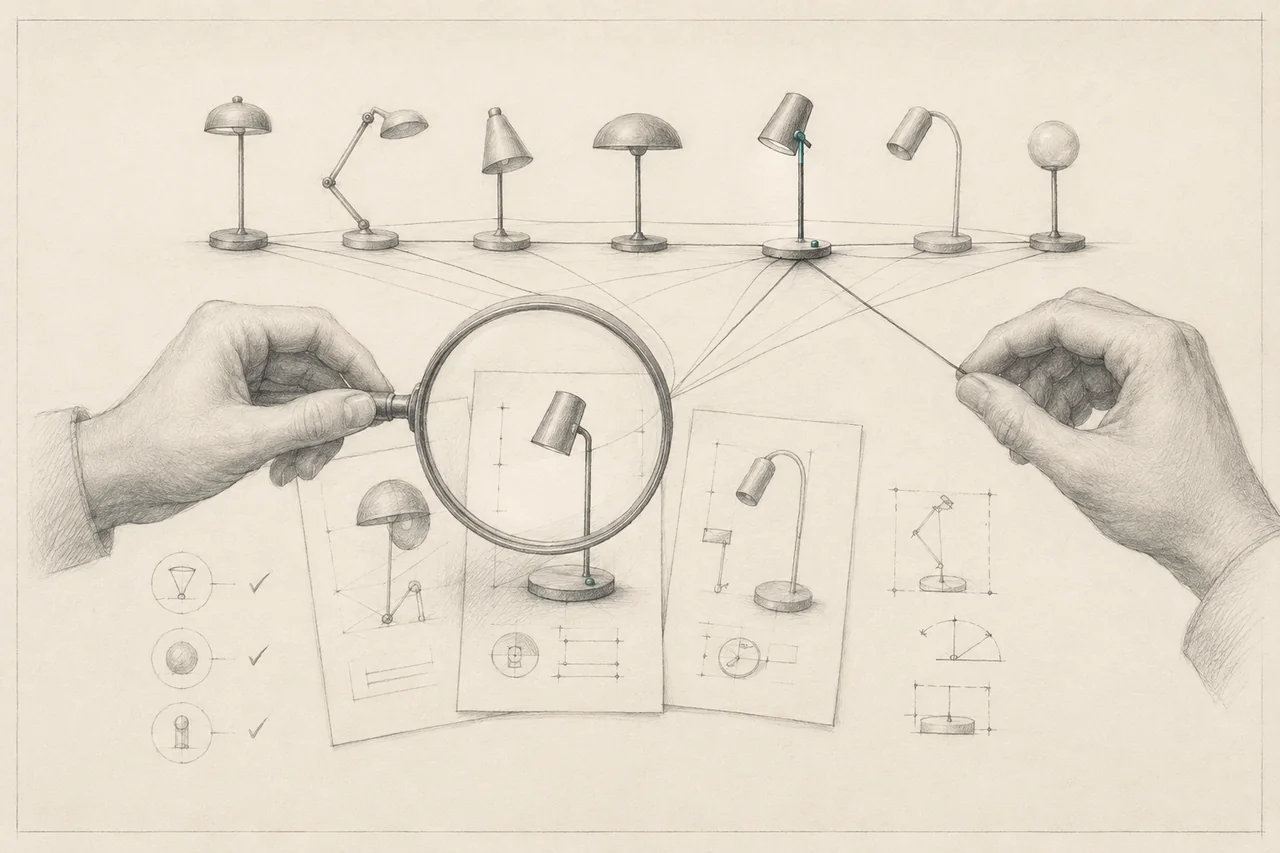
Traditional search starts with query matching. A customer often starts with a goal: a desk for a small shared room, equipment compatible with an existing setup, or a subscription that fits a specific routine. AI discovery can translate that need into catalogue constraints without requiring the customer to learn your taxonomy.
Capture the goal, use case and context that explain why the customer is shopping.
Ask about budget, compatibility, dimensions or other requirements that materially change the result.
Use stated preferences to rank eligible products. Keep optional preferences separate from hard requirements.
See the workflow
Select a step to see how the context, output and controls connect.
The customer describes a small desk and evening reading. Clarification turns that context into useful requirements.
Structured filters protect required dimensions and availability. Ranking helps order the remaining options.
Use product evidence to explain the fit and the tradeoff. Keep the comparison close to the next action.
The customer describes a goal in their own words.
Ask a useful follow-up when the answer would change the shortlist.
Filter out products that fail required constraints.
Order eligible options using the agreed matching logic.
Show supporting attributes and meaningful tradeoffs.
Open a PDP, compare products, add to cart or ask a specialist.
The architecture can combine structured product attributes with keyword or embedding search where relevant. Structured filtering protects hard requirements; business rules, inventory checks and ranking shape the shortlist. Recommendation explanations should reference the product evidence used, and analytics should show where a customer continues, revises a need or leaves. If the catalogue has no suitable match, the experience should say so and offer a useful next step.
These are possible applications. Each discovery experience is scoped around the actual catalogue and buying journey.
Match dimensions, materials and configuration requirements; make conflicting constraints visible.
Guide selection around stated preferences, use cases and approved product attributes.
Use specifications, compatibility and availability to make technical comparisons understandable.
Help customers compare plan boundaries, eligibility and recurring needs using approved information.
Lumethica can design the product discovery layer around your catalogue, customer journey and business logic rather than forcing the business into a generic interaction model. Discovery can live in a guided finder, comparison interface or shopping assistant. A product sprint defines the interaction and matching assumptions before an MVP is built.
Start with representative customer needs and known suitable products. Review shortlist quality, incompatible results and no-match behaviour with catalogue experts. In a pilot, measure whether users engage with recommended products, use comparison and reach the next action. Query volume alone does not show whether discovery is helping customers.
Related
FAQ
It can complement existing search or support a specific product finder. The right interface depends on how customers express their needs and where current search fails them.
First identify which attributes are essential for matching. The initial scope can use a reliable subset, with enrichment and review added for missing information.
Yes. The interface can show relevant attributes, unmet preferences and tradeoffs. Explanations should be grounded in approved catalogue information.
Yes. A bounded category makes it easier to evaluate relevance, compatibility rules and customer behaviour before extending the experience.
Define the first useful release
Start with your catalogue, current process and the outcome you want to improve.