AI product advisor

AI Guided Product Advisor

Turn product confusion into guided recommendations, explainable choices and better customer journeys.
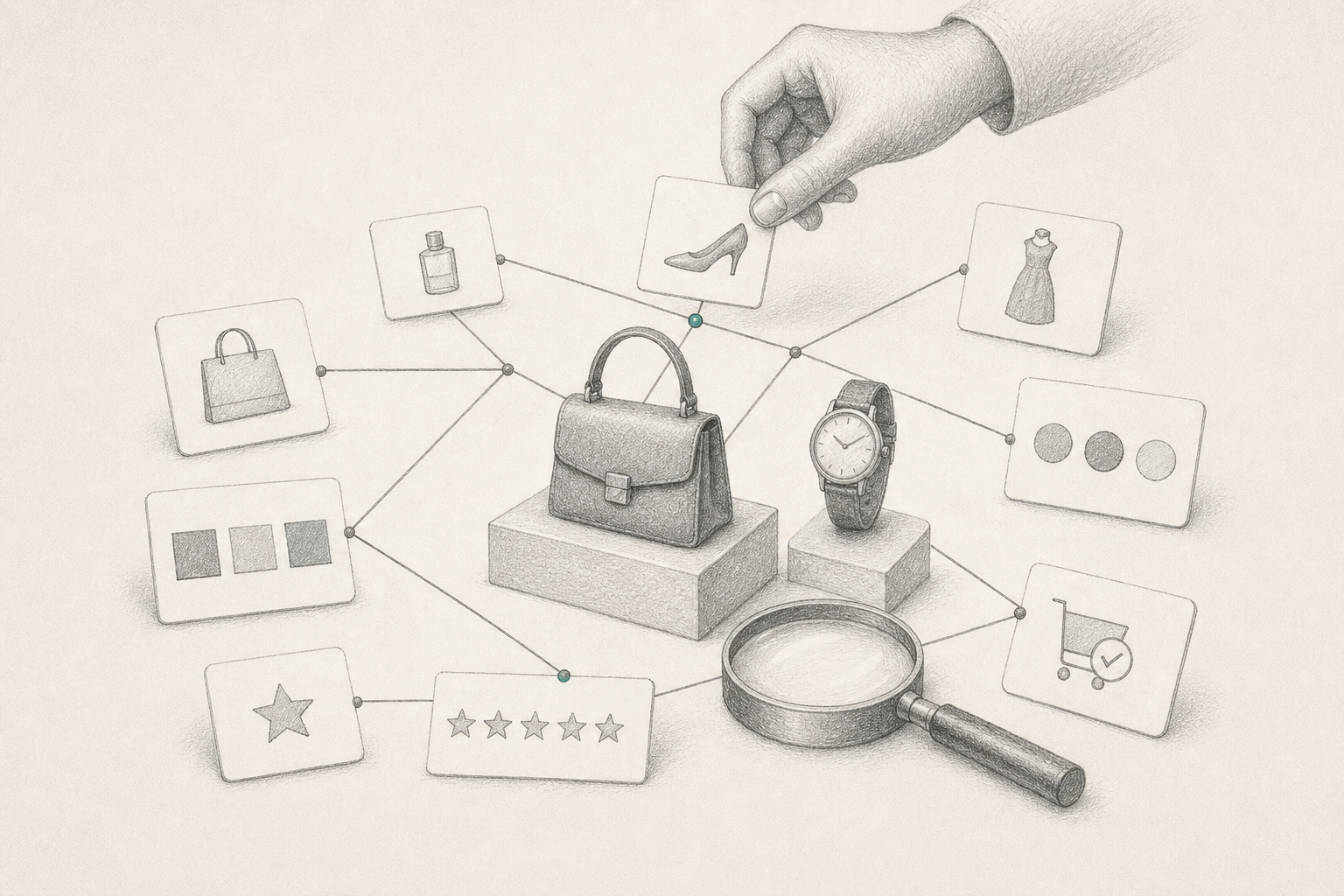
Graphite pencil illustration of a product box, magnifying glass, swatches and connected recommendation cards
AI Guided Product AdvisorNeed intake, product matching and explainable product choice.

Outcome

From product confusion to guided recommendations.

AI Guided Product Advisor is a customer-facing AI experience that asks the right questions, recommends suitable products or paths and explains trade-offs in plain language.

Higher conversion

Designed into the product workflow with clear owner, context and measurable outcome.

Lower product confusion

Designed into the product workflow with clear owner, context and measurable outcome.

Better recommendation data

Designed into the product workflow with clear owner, context and measurable outcome.

Use case clarity

Start with the workflow moment we want to improve.

Retail is moving toward AI-led commerce, reimagined marketing and AI-assisted customer engagement while consumers remain value-focused and choice-overloaded.

Step 01

Choose product category.

Solves Customers abandon journeys when product catalogs are too large or options look too similar.

How Recommended option: Durable daily-use product.

Step 02

Describe the customer need.

Solves Filters do not capture intent, context or trade-offs.

How Why this fits: The customer prioritizes reliability and long-term use over lowest price.

Step 03

AI asks 3-5 qualifying questions.

Solves Support teams answer repetitive pre-purchase questions.

How Alternative: Budget option if price becomes the main constraint.

Step 04

AI recommends 2-3 product options or one guided path.

Solves Retail teams need better insight into why customers hesitate before buying.

How Confidence: 86%

Step 05

AI explains trade-offs and sends the user to purchase, wishlist or human help.

Solves Customers abandon journeys when product catalogs are too large or options look too similar.

How Next step: Show comparison card and offer human confirmation.

From browse to fit

A shopper's need becomes a smaller, clearer set of choices.

The advisor asks useful questions, connects catalogue context and explains why a product or path fits.

1

Choose product category.

Need intake

2

Describe the customer need.

Guided qualification questions

3

AI asks 3-5 qualifying questions.

Product recommendation card

4

AI recommends 2-3 product options or one guided path.

The next step is logged, routed and ready for human review where needed.

Working underneathCatalogue dataPreference logicComparison modeCheckout handoff

Trust & Control Layer

Useful AI with visible boundaries.

The advisor should explain why each product is recommended and what trade-offs exist, especially when price, quality, warranty or suitability matter.

Product architecture

Core modules and data sources.

Retailers and ecommerce brands with broad catalogs, complex products, high-consideration purchases or frequent pre-purchase questions.

Includes

Designed as a product system.

Not designed for: Stores with very small catalogs and simple impulse purchases where search and filters already work well.

Need intakeGuided qualification questionsProduct recommendation cardTrade-off explanationComparison modeInventory and availability awarenessShopifyWooCommerceproduct cataloginventorypricingreviews

Delivery model

From product sprint to MVP and optimization.

1

Product Sprint

Map the decision journey, UX flow, AI behavior and trust boundaries.

2

MVP Build

Build the assistant, knowledge layer, handoff and measurement loop.

3

Optimization

Improve prompts, flows, analytics, content and business outcomes.

Related solutions
Explore adjacent AI product patterns.

Final CTA

From product confusion to guided recommendations.

Book an AI Opportunity Call